
Status of Offshore Wind Energy Development in Germany
First Half of 2026
|
Status: 30. June 2026
1,764 Offshore wind turbines (OWT) | 10,8 GW Capacity of offshore wind turbines
Offshore Wind Energy Development
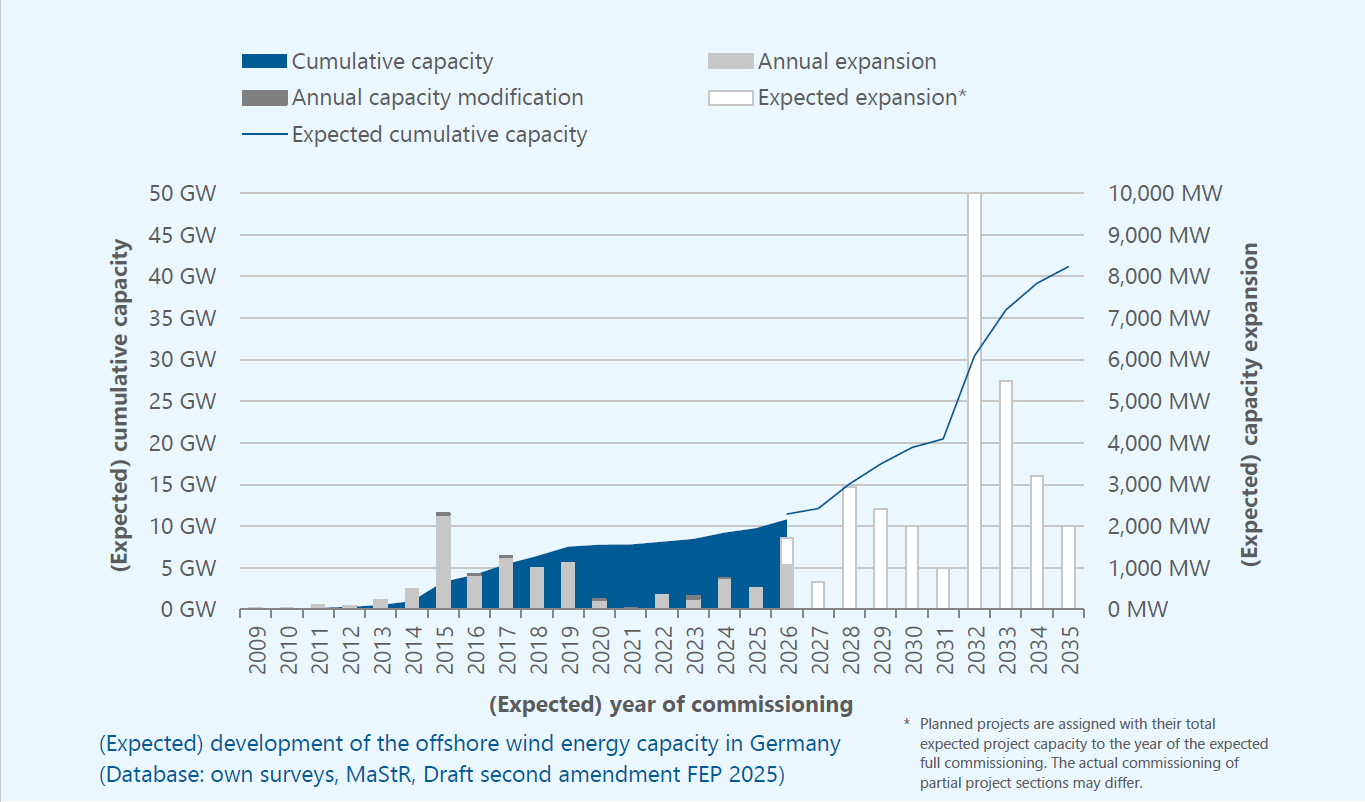
As of June 30, 2026, 1,764 offshore wind turbines (OWT) with a total capacity of around 10.8 GW are in operation in Germany. In the first half of 2026, 84 offshore wind turbines with a total capacity of 1.1 GW fed electricity into the grid for the first time.
Including the turbines installed in the first half of 2026, there are a total of 1,786 offshore wind turbines off the German coast as of mid-2026; 22 of these turbines have not yet started feeding electricity into the grid and have therefore not yet been commissioned. In addition, 65 foundations have been installed in the seabed and are expected to be equipped with offshore wind turbines in the coming months.
A significant increase in total installed capacity in Germany is planned for the next ten years. This requires a high annual rate of expansion and the commissioning of all planned offshore wind turbines according to schedule.

Expansion Targets Offshore Wind Energy
The expansion targets for offshore wind energy are defined in the German Offshore Wind Energy Act (German: Windenergie-auf-See-Gesetz or WindSeeG). It specifies that the installed capacity of turbines connected to the grid is to be increased to at least 30 GW by 2030, to at least 40 GW by 2035 and to at least 70 GW by 2045.
To achieve these targets, the Federal Maritime and Hydrographic Agency (German: Bundesamt für Seeschifffahrt und Hydrographie or BSH) continuously sets new specifications for future expansion in the Site Development Plan (German: Flächenentwicklungsplan or FEP), particularly regarding wind energy sites and the associated grid connections, the calendar years for tenders and commissioning.
The FEP 2025 was published in January 2025, followed by the first amendment in January 2026 and the draft of the second amendment in June 2026. The first amendment provided for the postponement of tenders and commissioning for some sites and grid connections. The draft of the second amendment provides for further postponements as well as the cancellation of tenders.
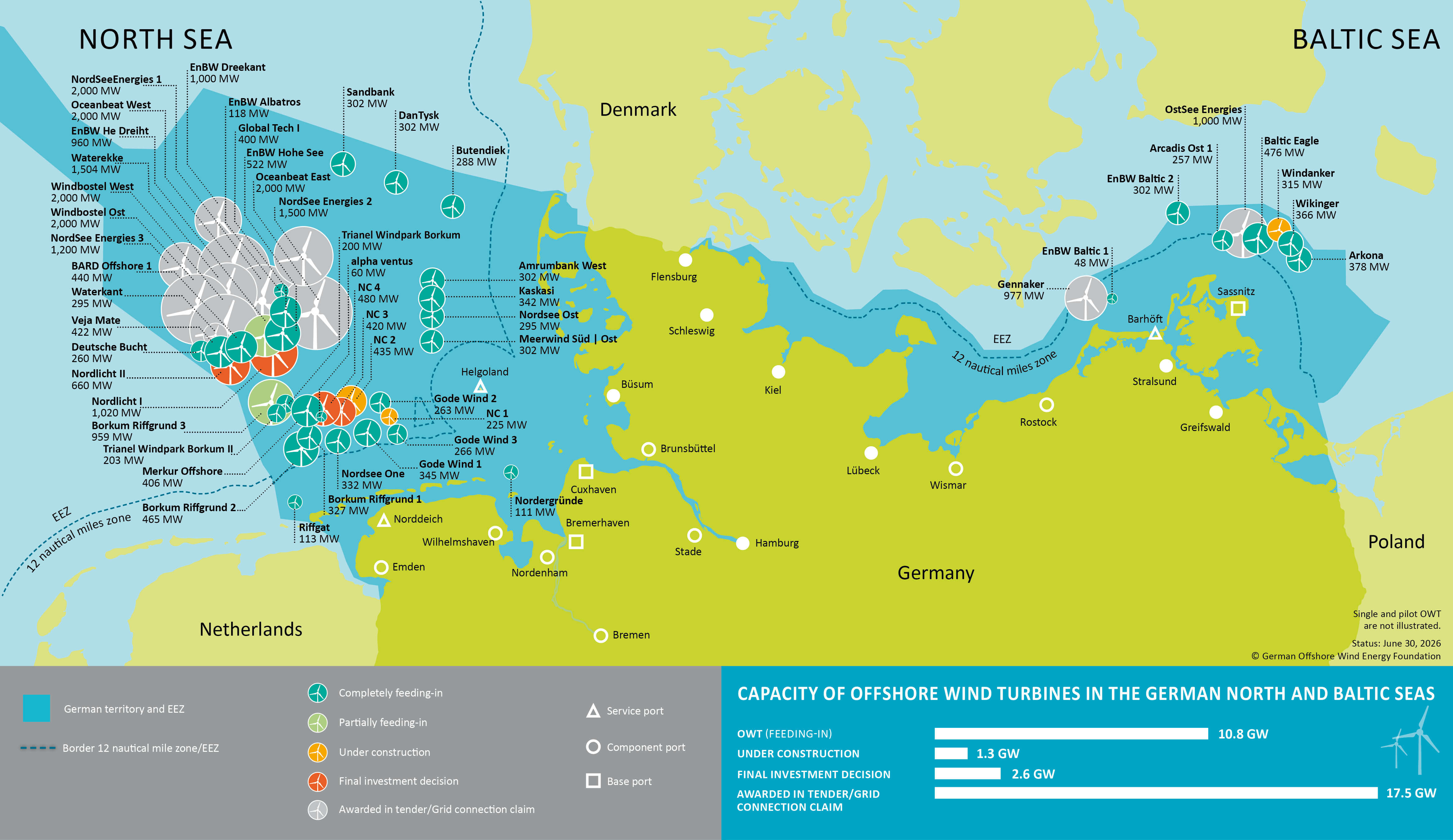
Overall, the current plans extend to 2035 and encompass a total capacity of approximately 41 GW. As of mid-year, this capacity is at various stages of development. A total of 10.8 GW is already in operation, another 1.3 GW is under construction, and a final investment decision has been made for 2.6 GW. Less advanced in terms of project implementation are 17.5 GW that have been awarded or have a grid connection claim, and 9 GW that have so far only been designated for tenders and have not yet been awarded to any project developer. As a result, the 2030 expansion target can no longer be met in time; the 2035 target could be achieved if all projects are implemented as planned; and further specifi-cations are still needed regarding the 2045 target.
Activities in Offshore Wind Energy Projects
As of mid-2026, 31 offshore wind energy projects (OWP) are fully operational in Germany. The installation of the turbines in the Borkum Riffgrund 3 OWP was completed in early 2025. In the EnBW He Dreiht project, the installation of the turbines is mostly completed. In both projects, the majority of the offshore wind turbines have already been commissioned; the remaining turbines are scheduled to follow in the second half of 2026.
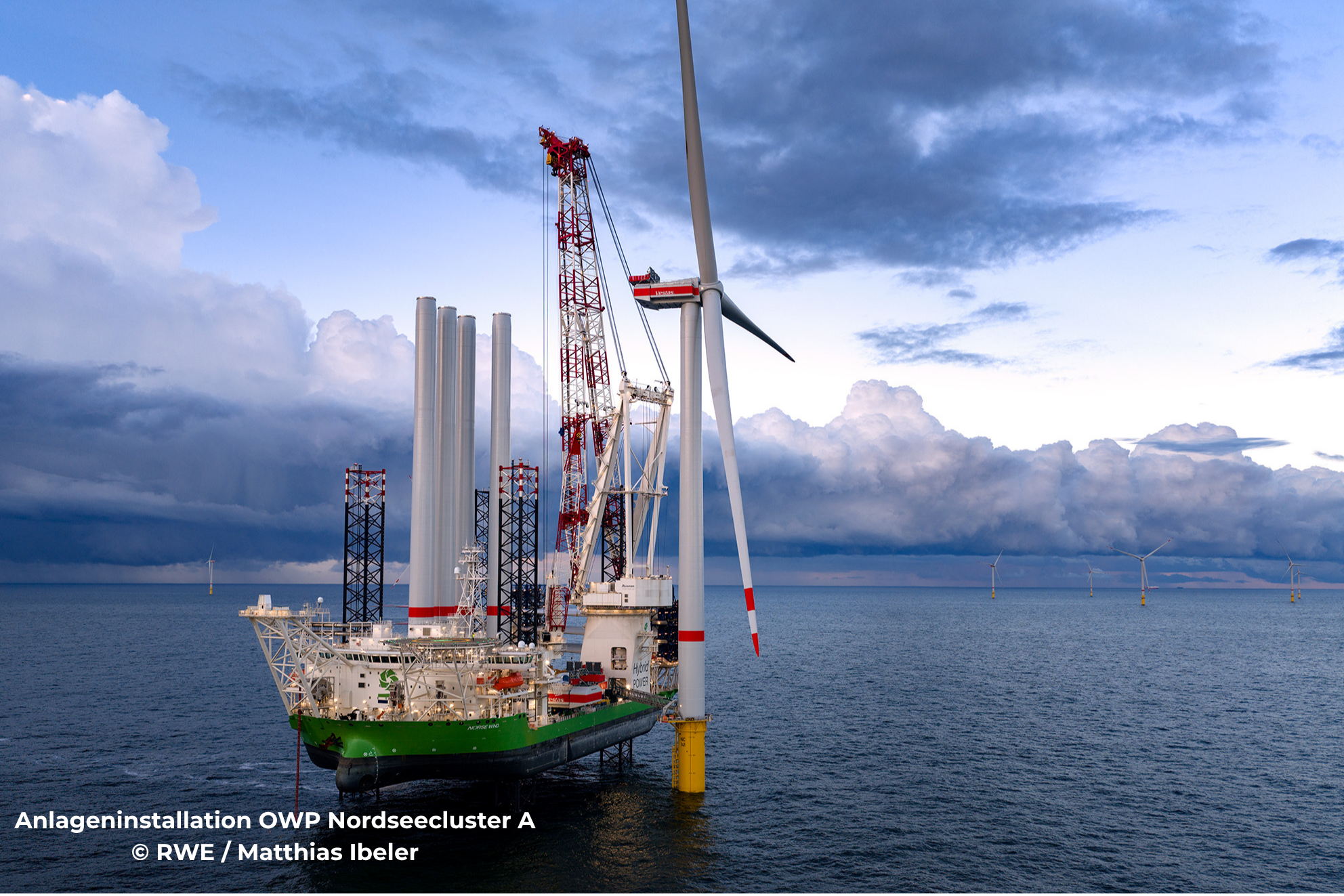
In the North Sea Cluster A (NC 1 and NC 2) as well as in the Windanker project, the foundations were successfully installed by the end of 2025. In North Sea Cluster A, turbine installation began in June 2026. These works began at the Windanker project in July 2026, which is the second half of 2026. Construction on the OWP Nordlicht I also began in July 2026. Another 15 projects are still in earlier stages of development and implementation.